Procedural art · mathematics · physics

Pictures nobody drew.

Each work here is an instrument: a real piece of optics, fluid dynamics or dynamical systems, tuned by hand. Nothing represents anything. The image is what the equations do when light, flow or time is let loose on them — and the link in your address bar reproduces it exactly.

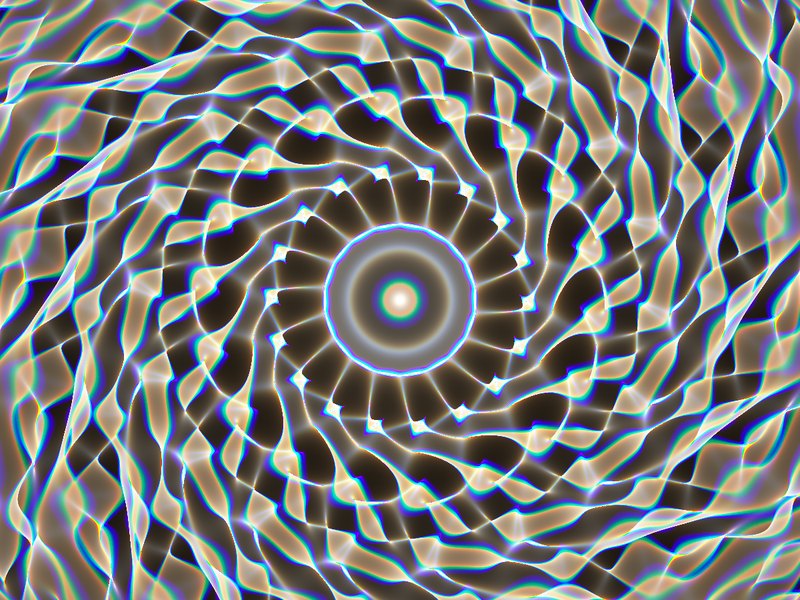
Spectral caustics in sevenfold quasicrystal symmetry
Geometric optics · quasicrystals

Caustica

White light falls through glass whose relief is a quasicrystal. Rays crowd into caustics on the floor and split into their spectrum.
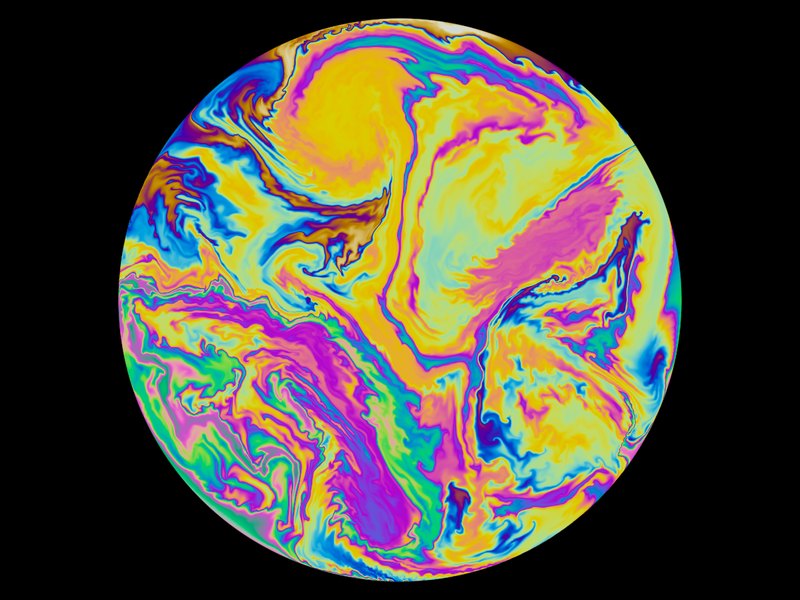
A swirling soap film in interference colours
Wave optics · fluid dynamics

Pellicle

A soap film in a ring, alive: thin film rises, gravity drains it, the rim breeds turbulence. Every colour is interference of light.
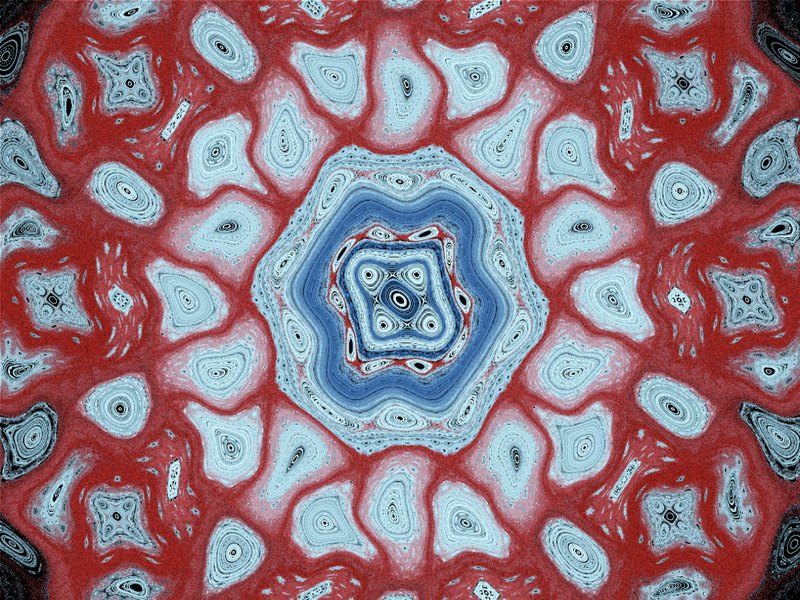
A fivefold web of chaotic orbits around islands of order
Hamiltonian chaos · KAM theory

Quasiweb

Thousands of orbits of kicked oscillators. Chaos weaves a quasicrystal web; each island of order is coloured by its own frequency.
Homages

After Vasarely and Molnár.

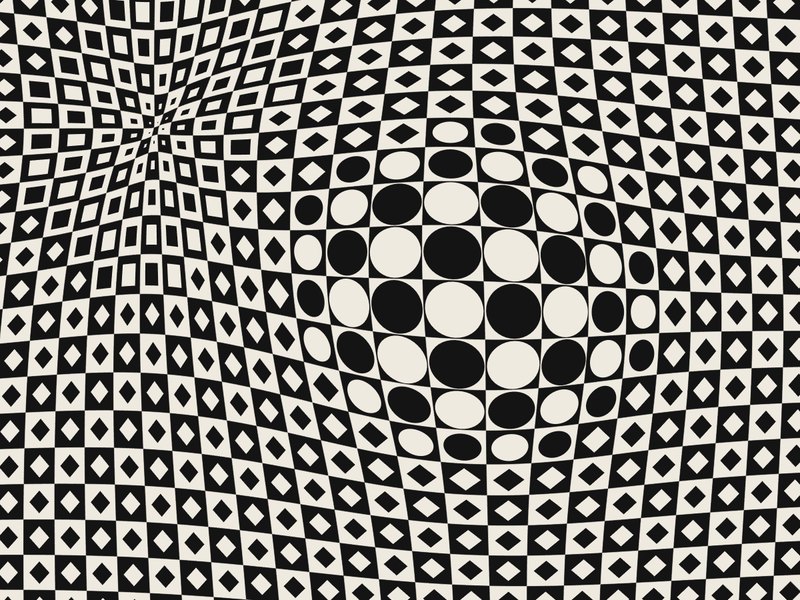
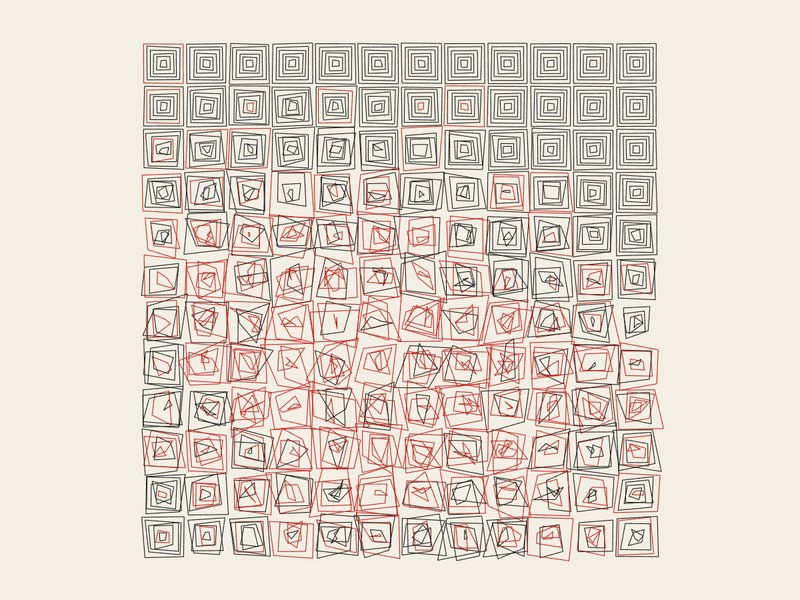
Victor Vasarely made the grid swell; Vera Molnár asked how much disorder an order can take. Four instruments take their questions one step further — the bulge becomes a field, the disorder becomes heat, the strokes become a liquid crystal, the cubes become a theorem.

A Vasarely grid of plastic units bulging round two lens centres
After Vasarely · gravitational lensing

Unité

Vasarely's plastic units on a grid bent by a real field — a softened gravitational lens, a sphere, a vortex. The forms swell with the magnification.

Molnár-style concentric squares growing disordered where it is hot
After Molnár · heat diffusion

Désordre

Vera Molnár's concentric squares, where the disorder is heat diffusing from its sources. Strokes only: the SVG goes straight to a pen plotter.

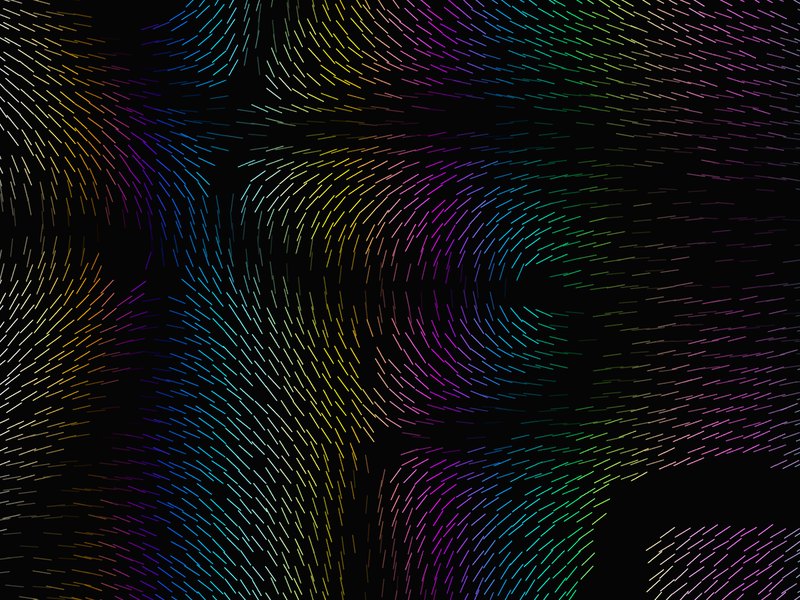
Short coloured strokes following a liquid-crystal field between crossed polarisers
After Molnár · liquid crystals

Nematic

Molnár's Interruptions written by a liquid crystal: strokes follow the director round its defects, and polarised light colours them.

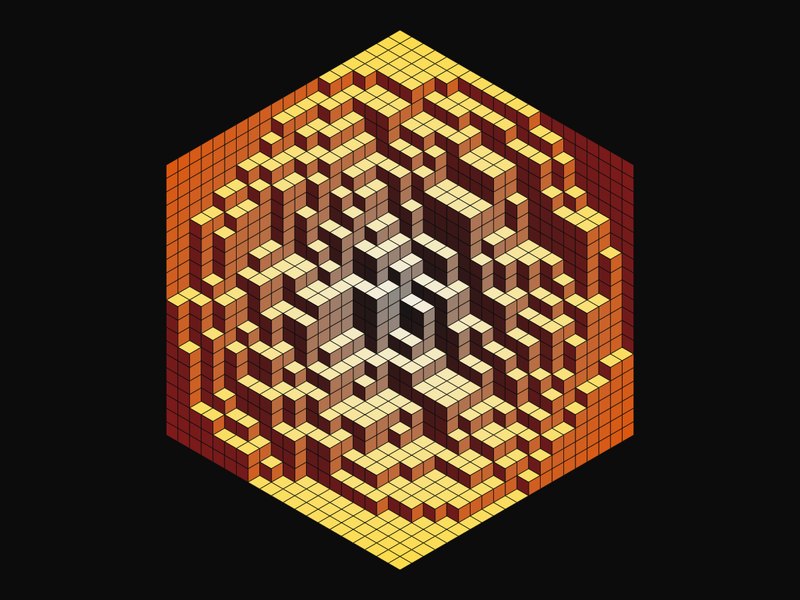
Isometric cubes forming a random lozenge tiling of a hexagon
After Vasarely · random tilings

Arctic

Vasarely's cubes as a random tiling of a hexagon. A Markov chain stacks them; order freezes in the corners and melts inside the arctic circle.

No pictures of things

Non-representational by construction. There is no subject to depict — only a system and the way it behaves.

Real models

Snell's law with dispersion, Airy's thin-film reflectance, incompressible flow, area-preserving maps, lensing, diffusion, nematic order, random tilings. The beauty is the physics, not a filter on top of it.

Yours to make

Tune it, randomize it, plant your own orbits, stir the film. Save a print-size PNG or a plotter-ready SVG; every setting lives in the link.

In your browser

Everything runs on your device. No account, no upload, no tracking.